




NAATI CCL vocabulary plays a critical role for candidates who want to pass the NAATI CCL test and maximise their Australian PR points.
Health and medical topics are among the most frequently tested areas in NAATI CCL role-plays, which means candidates must develop strong medical terminology, accurate interpreting skills, and a solid understanding of context.
In this guide, you will find a comprehensive NAATI CCL medical vocabulary list, practical healthcare dialogue examples, and proven strategies to confidently manage medical role-play NAATI scenarios.
🔑: Key Highlights
-
- 1. Complete Health & Medical Vocabulary Coverage: A structured and exam-focused NAATI CCL medical vocabulary list covering general medical terms, symptoms, hospital terminology, pharmacy language, and insurance-related expressions.
- 2. Realistic Healthcare Dialogue Practice: Sample NAATI CCL healthcare dialogue and common medical role-play NAATI situations to help you understand real exam patterns and improve interpretation accuracy.
- 3. Practical Strategies for Better Community Interpreting: Actionable tips to strengthen community interpreting vocabulary, avoid common mistakes, and handle complex health-related conversations with confidence.
Understanding Health & Medical Topics in NAATI CCL Vocabulary
The NAATI CCL (Credentialed Community Language Test), conducted by the National Accreditation Authority for Translators and Interpreters, assesses your ability to interpret conversations between an English-speaking professional and a non-English speaker in community settings.
Health-related conversations are extremely common in the test because medical communication is a major part of community interpreting. These interactions typically occur between:
- a. Doctor and patient
- b. Nurse and patient
- c. Receptionist and patient
- d. Pharmacist and customer
- e. Specialist and family member
To succeed in health-related role-plays, you must be confident with:
- a. Medical terminology
- b. Healthcare system vocabulary
- c. Appointment and prescription language
- d. Emergency-related terms
- e. Insurance and billing expressions
Why Health Vocabulary Is Important for NAATI CCL
Medical role-plays can be challenging because:
- a. They contain technical terminology.
- b. Accuracy is essential.
- c. Misinterpretation can change the meaning entirely.
- d. Situations may involve urgency or emotional stress.
Strong community interpreting vocabulary in health topics ensures:
- a. Clear and accurate communication
- b. Professional terminology usage
- c. Confidence during interpretation
- d. Higher chances of achieving a strong score
NAATI CCL Health Vocabulary List
Below is a structured and practical NAATI CCL medical vocabulary list that commonly appears in healthcare dialogues.
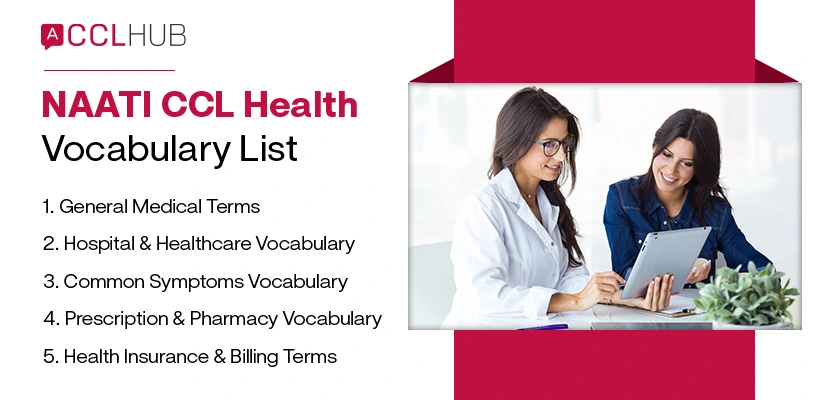
1. General Medical Terms
| English Term | Meaning/Context |
| General Practitioner (GP) | Family doctor |
| Specialist | Doctor with advanced expertise |
| Appointment | Scheduled a meeting with the doctor |
| Consultation | Medical discussion |
| Diagnosis | Identification of illness |
| Treatment | Medical care given |
| Prescription | Doctor’s written medicine order |
| Medication | Medicine |
| Symptoms | Signs of illness |
| Condition | Health state |
| Chronic | Long-term illness |
| Acute | Severe and sudden |
| Infection | Disease caused by bacteria/virus |
| Inflammation | Swelling/redness |
| Allergy | Immune reaction |
2. Hospital & Healthcare Vocabulary
These terms are commonly used in NAATI CCL healthcare dialogue scenarios.
| English Term | Meaning/Context |
| Emergency Department | Hospital emergency unit |
| Admission | Entering the hospital for treatment |
| Discharge | Leaving hospital |
| Ward | Hospital section |
| Intensive Care Unit (ICU) | Critical care section |
| Surgery | Operation |
| Surgeon | Doctor performing surgery |
| Nurse | Medical care provider |
| Medical history | Past health records |
| Referral | Recommendation to the specialist |
| Bulk billing | Government-covered medical payment |
| Medicare | Australia’s public health system |
3. Common Symptoms Vocabulary
Medical role-play NAATI conversations often include symptom descriptions.
| Symptom | Related Expression |
| Fever | High temperature |
| Headache | Pain in the head |
| Nausea | Feeling like vomiting |
| Vomiting | Throwing up |
| Dizziness | Feeling faint |
| Shortness of breath | Difficulty breathing |
| Chest pain | Pain in the chest area |
| Fatigue | Extreme tiredness |
| Cough | Throat irritation |
| Rash | Skin redness |
4. Prescription & Pharmacy Vocabulary
| English Term | Meaning |
| Dosage | Amount of medicine |
| Side effects | Unwanted reactions |
| Over-the-counter | No prescription needed |
| Antibiotics | Bacterial infection medicine |
| Painkillers | Pain relief medicine |
| Tablet | Pill |
| Syrup | Liquid medicine |
| Injection | Medicine through needle |
| Expiry date | Validity period |
| Repeat prescription | Refill medicine |
5. Health Insurance & Billing Terms
| English Term | Context |
| Private insurance | Non-government health coverage |
| Claim | Request for reimbursement |
| Coverage | Insurance benefits |
| Gap payment | Extra payment required |
| Out-of-pocket expenses | Personal payment |
Sample NAATI CCL Healthcare Dialogue
Below is a short example of an NAATI CCL healthcare dialogue for practice.
Scenario: Doctor and Patient
Doctor: What symptoms have you been experiencing?
Patient: I have had a persistent cough and mild fever for three days.
Doctor: Do you have any allergies or existing medical conditions?
Patient: I have asthma, and I’m allergic to penicillin.
Doctor: I will prescribe antibiotics and recommend a chest X-ray.
When practising:
- 1. Break sentences into meaningful segments.
- 2. Avoid literal, word-for-word translation.
- 3. Focus on accuracy and clarity.
Medical Role Play NAATI: Common Situations
Here are typical health-related role-play situations:
- Booking a GP appointment
- Explaining the surgery procedure
- Discussing test results
- Emergency room admission
- Vaccination consultation
- Mental health counselling
- Pregnancy check-up
- Child immunisation
Preparing vocabulary for these situations increases your fluency and reduces hesitation during the test.
Advanced Community Interpreting Vocabulary (Health Context)
To score higher, you should also learn formal and semi-formal expressions.
| Formal Expression | Simple Meaning |
| Underlying condition | Existing illness |
| Medical practitioner | Doctor |
| Adverse reaction | Negative response |
| Preventive care | Avoidance treatment |
| Follow-up appointment | Next visit |
| Informed consent | Patient agreement |
| Confidentiality | Privacy protection |
| Diagnostic test | Medical examination |
Tips to Memorise NAATI CCL Health Vocabulary
1. Study by Categories
Group vocabulary into themes like symptoms, hospital, pharmacy, and insurance.
2. Practise Role-Plays Daily
Simulate medical role-play NAATI conversations with a partner.
3. Record Your Practice
Evaluate your fluency and terminology accuracy.
4. Prioritise Accuracy Over Speed
Medical interpretation must be precise.
5. Learn Both Technical and Simple Terms
Understanding equivalent expressions improves flexibility.
Common Mistakes in Health Topic Interpretation
- 1. Misinterpreting dosage instructions
- 2. Confusing chronic and acute conditions
- 3. Skipping important details
- 4. Translating literally instead of contextually
- 5. Forgetting numbers and medical measurements
Avoiding these mistakes significantly improves your score.
Why Choose CCL Hub for Preparation?
If you are looking for structured and reliable preparation support, CCL Hub offers exam-focused materials across all major topics. From updated health and medical vocabulary lists to real exam-style role-plays and guided practice sessions, CCL Hub provides resources designed to reflect actual NAATI standards.
Whether your focus is healthcare, legal, education, or social services, their targeted preparation approach helps you strengthen community interpreting vocabulary, improve accuracy, and build real exam confidence.
Conclusion
Mastering NAATI CCL health vocabulary and NAATI CCL medical vocabulary is essential for achieving a high score in the CCL exam. Health-related dialogues are detailed, terminology-heavy, and require precise interpretation skills.
By building strong community interpreting vocabulary, practising realistic NAATI CCL healthcare dialogue samples, and preparing for various medical role-play NAATI scenarios, you can approach the exam with professionalism and confidence.
With consistent practice, structured vocabulary learning, and exam-oriented preparation, success in the health and medical topic of NAATI CCL becomes achievable and realistic.
Choose Your NAATI CCL Language Package
Gain 5 extra PR points with expert-led NAATI CCL preparation.
Select your language and start your success journey today.
Nepali NAATI CCL
High success-rate package with real exam-style dialogues and mock tests.
Hindi NAATI CCL
Step-by-step preparation covering vocabulary, role plays, and strategies.
Not sure which NAATI CCL package is right for you?
Get a Free Consultation
