
 ¡VAMOS ESPAÑA!


Thousands of aspiring migrants take the NAATI CCL test every year to secure five precious Australian PR points. Yet many well-prepared candidates fail not because they lack language skills, but because they struggle with time pressure.
If you’re preparing for your NAATI CCL exam, you know that interpreting accurately between English and your community language is challenging. Add strict timing constraints, and the pressure multiplies. The difference between passing and failing often comes down to how you manage naati ccl exam timing.
Effective naati ccl time management isn’t just about watching the clock it’s about pacing yourself, staying calm, and delivering your interpretation smoothly within the allocated time. This guide breaks down everything you need to know about the exam’s timing structure, how long each dialogue lasts, and proven strategies to keep you on track during test day.
Whether you’re concerned about naati ccl role play duration or simply want to refine your exam approach, this article provides practical techniques to boost your confidence and performance.
What is the NAATI CCL Exam Timing?
The NAATI CCL (Credentialed Community Language) assessment is a computer based test which determines your proficiency in interpreting between English and your selected community language in real life situations. The whole test has a two-dialogue format where each dialogue depicts a real-life conversation you may be involved in during your healthcare appointment, legal meeting, educational meeting, or social services discussion in the Australian community.
Total Exam Duration:
The complete NAATI CCL exam typically lasts approximately 20 to 25 minutes, though the actual interpreting portion takes around 15–20 minutes. This includes:
- Two complete dialogues (role plays)
- Each dialogue contains multiple segments (usually 30–35 segments combined across both dialogues)
- Brief pauses between segments for you to interpret
- Automatic transitions managed by the computer system
How Timing Works:
Unlike traditional face-to-face interpreting, the NAATI CCL test is pre-recorded. You’ll hear each dialogue segment once, then you must interpret it immediately. There’s no rewind button, no second chance to hear the audio, and the system automatically moves to the next segment once you finish speaking or after a set pause duration.
This automatic progression is what makes naati ccl exam timing so crucial. You cannot control when the next segment plays you can only control how efficiently you use the time between segments.
Understanding NAATI CCL Role Play Duration
Each of the two dialogues in your NAATI CCL exam represents a complete conversation between two speakers. Let’s break down exactly how long these role plays last and what you need to accomplish within that timeframe.
Individual Dialogue Duration:
Each dialogue typically runs for approximately 7 to 10 minutes from start to finish. This includes:
- The time for all audio segments to play
- Your interpretation time for each segment
- Brief pauses between segments
Segment-by-Segment Breakdown:
Each dialogue is divided into smaller segments (usually 15–18 segments per dialogue). A single segment typically contains:
- Audio length: 20–40 seconds of speech
- Your response time: You generally have a similar amount of time (sometimes slightly more) to deliver your interpretation
- Natural pauses: The system allows a brief thinking time before you begin
The Reality of NAATI CCL Role Play Duration:
Here’s what candidates often don’t realise: the naati ccl role play duration isn’t just about the total minutes, it’s about the rapid-fire pace of segment transitions. You might have:
- 30 seconds to listen
- 35–40 seconds to interpret
- 2–3 seconds before the next segment begins
Common Timing Challenges:
- Segment length varies: Some segments are just one sentence; others contain multiple ideas
- Information density: Medical or legal dialogues pack more technical terms into shorter segments
- Speaker speed: Some recorded speakers talk faster than others
- Automatic cutoffs: If you take too long, the next segment may begin while you’re still speaking
Understanding these realities helps you prepare mentally for the exam’s actual rhythm and pace.
Step-by-Step Time Management Strategy
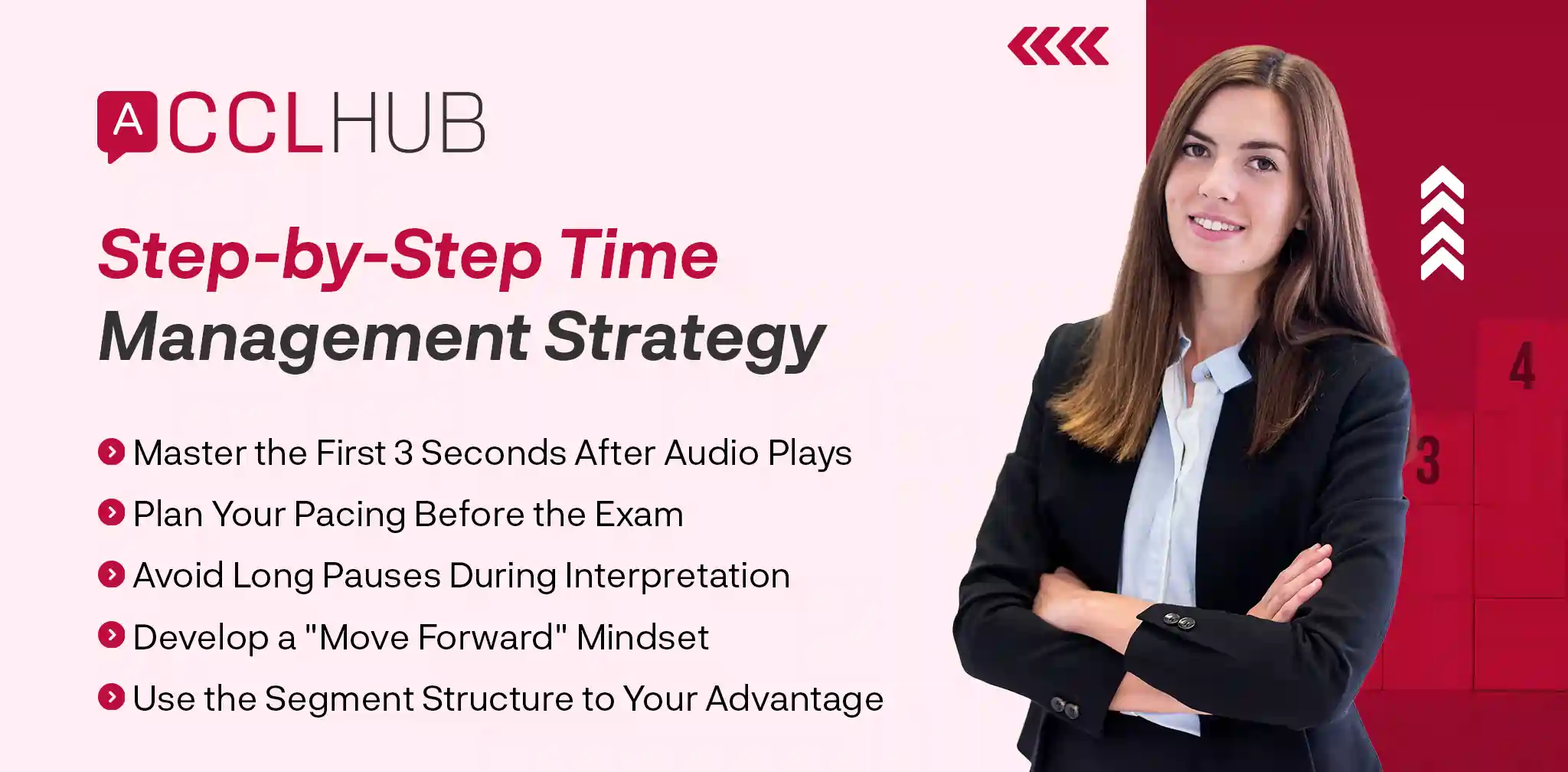
Now that you understand the timing structure, let’s explore practical strategies to help you manage every precious second during your NAATI CCL exam.
1. Master the First 3 Seconds After Audio Plays
The moment after each segment finishes is critical. Here’s your immediate action plan:
- Take a breath: A quick inhale calms nerves and gives you a micro-pause to collect thoughts
- Glance at your notes: If you’ve jotted keywords, scan them quickly
- Start speaking within 2–3 seconds: Don’t overthink begin with confidence
Pro tip: Practice starting your interpretation immediately after the audio stops. This trains your brain to process and speak simultaneously, reducing dead time.
2. Plan Your Pacing Before the Exam
Effective pacing means matching your interpretation speed to the segment length:
- For short segments (1–2 sentences): Aim to finish in 20–30 seconds
- For longer segments (3–4 sentences): Allow 35–45 seconds
- Always leave a 2–3 second buffer: This prevents you from being cut off mid-sentence
3. Avoid Long Pauses During Interpretation
Extended silences damage your fluency score and waste valuable time:
- If you forget a word: Use a close equivalent or description rather than stopping completely
- If you lose your place: Continue with what you remember rather than freezing
- Keep vocal energy consistent: Even brief pauses should feel intentional, not panicked
4. Develop a “Move Forward” Mindset
One of the biggest time-wasters is dwelling on mistakes:
- Don’t self-correct extensively: Minor errors are acceptable; major corrections take time you don’t have
- Release missed information: If you didn’t catch a detail, let it go and focus on the next segment
- Trust your preparation: Your practice has built the skills you need
5. Use the Segment Structure to Your Advantage
Each segment typically follows a logical structure:
- Main point first: Lead with the primary message
- Supporting details second: Add context if time permits
- Mirror natural speech rhythm: Speak as you would in real conversation, not like you’re reading a script
Real-Exam Time Tips & Shortcuts
Beyond general strategy, here are specific techniques that successful candidates use to maximize their naati ccl time management:
Smart Note-Taking vs. Speaking Time
The Balance:
- Note-taking should take 5–7 seconds maximum per segment
- Write only critical keywords: numbers, names, technical terms
- Use abbreviations and symbols you’ll recognize instantly
What to Skip:
- Don’t write complete sentences
- Don’t waste time on common words you’ll remember
- Don’t organize notes neatly functionality over appearance
How to Use a Timer During Practice
Incorporate timing into your study routine:
- Record yourself interpreting practice dialogues
- Set a timer for each segment: Aim to finish within 5–10 seconds of the audio length
- Review your recordings: Identify where you’re too slow or rushing
- Gradually reduce your response time: Start with generous time limits, then tighten them as you improve
Recommended Practice Schedule:
- Week 1–2: Focus on accuracy without time pressure
- Week 3–4: Introduce gentle time limits (1.5x audio length)
- Week 5–6: Practice at exam pace (1x to 1.25x audio length)
Balancing Accuracy and Speed
This is the eternal NAATI CCL dilemma. Here’s the truth:
Accuracy beats speed, but chronic slowness loses points too.
The sweet spot:
- Aim for 85–90% accuracy at conversational pace
- Accept that some minor details may be omitted under time pressure
- Prioritize meaning over word-for-word translation
- Deliver core messages clearly and confidently
Speed shortcuts that maintain accuracy:
- Use natural equivalents instead of searching for “perfect” translations
- Chunk information into meaningful units rather than translating individual words
- Practice common phrase patterns until they become automatic
Common Time Management Mistakes (and How to Prevent Them)
Even experienced candidates fall into these timing traps. Here’s how to sidestep them:
Mistake 1: Over-Speaking
The Problem: Adding unnecessary elaborations or repeating information to sound thorough.
The Solution:
- Stick to the segment’s content nothing more, nothing less
- Trust that complete = accurate, not lengthy
- Practice delivering concise interpretations
Mistake 2: Translating Word-by-Word
The Problem: Attempting to find exact equivalents for every single word eats up time and sounds unnatural.
The Solution:
- Focus on conveying meaning, not matching vocabulary
- Use idiomatic expressions in your target language
- Remember: NAATI values natural communication over literal translation
Mistake 3: Hesitating Too Long at the Start
The Problem: Overthinking your opening sentence creates a domino effect of time pressure.
The Solution:
- Rehearse standard opening phrases for common dialogue types
- Start with what you know confidently, even if it means slight reordering
- Accept that your first words don’t need to be perfect
Mistake 4: Panicking When You Miss Information
The Problem: Stopping completely or backtracking when you didn’t catch something.
The Solution:
- Acknowledge internally that you missed it and move forward
- Continue with the surrounding context often the meaning becomes clear
- Don’t announce “I missed that” or apologize just keep interpreting
Mistake 5: Ignoring Practice Timing
The Problem: Practicing without time constraints, then being shocked by exam pace.
The Solution:
- Always simulate real exam conditions during at least 50% of your practice
- Use official NAATI sample tests with authentic timing
- Record and review timed practice sessions regularly
Practice Plan to Improve Timing
Developing excellent naati ccl time management requires deliberate, structured practice. Here’s a proven training plan:
Week-by-Week Practice Progression
Weeks 1–2: Foundation Building
- Practice individual segments without time pressure
- Focus on accuracy and natural expression
- Build vocabulary and familiarity with dialogue types
Daily drill:
- 20 segments interpreted (10 English→LOTE, 10 LOTE→English)
- Review recordings for accuracy
- Note areas of hesitation
Weeks 3–4: Introducing Time Awareness
- Begin timing individual segments
- Allow 1.5x the audio length for your interpretation
- Start reducing note-taking time
Daily drill:
- 15 timed segments with timer feedback
- 2 complete dialogues (untimed)
- Identify timing patterns (where you’re consistently slow)
Weeks 5–6: Exam Simulation
- Practice full dialogues at the exact exam timing
- Use NAATI official samples or CCLHub mock tests
- Simulate a complete test experience (both dialogues back-to-back)
Daily drill:
- 1 full mock test under strict time conditions
- 10 additional segments for skill refinement
- Self-assessment using NAATI marking criteria
Recommended Practice Drills
- The Speed Ladder Drill:
- Take one segment
- First pass: Interpret at a comfortable pace
- Second pass: Reduce time by 10%
- Third pass: Match exact audio length
- Review: Which version maintained the best accuracy?
- The No-Notes Challenge:
- Practice segments without writing anything
- Forces you to develop memory and instant recall
- Improves your actual speaking time vs. preparation time
- The Consecutive Segment Sprint:
- Practice 5 segments in a row without stopping
- Builds stamina and simulates exam pressure
- Helps you maintain concentration across entire dialogues
- The Weak Spot Focus:
- Identify dialogue types where you’re slowest (medical, legal, educational)
- Dedicate 20 minutes daily to only those topics
- Build terminology and confidence in challenging areas
Conclusion
Mastering naati ccl time management is just as important as developing your interpreting skills. Understanding the naati ccl exam timing structure, knowing the naati ccl role-play duration, and implementing strategic time-management techniques can dramatically improve your confidence and performance on test day.
Remember these key takeaways:
- The exam moves at a fixed pace you must adapt to it, not the other way around
- Each segment requires immediate response, minimal note-taking, and conversational delivery
- Accuracy matters most, but chronic slowness will cost you points
- Consistent, timed practice builds the muscle memory you need for exam success
- Managing your mental state and avoiding panic is half the battle
The candidates who pass NAATI CCL aren’t always the most naturally talented linguists; they’re often the ones who’ve practised smartly, prepared thoroughly, and learned to work efficiently within time constraints.
Start implementing these time management strategies in your practice sessions today. Track your progress, identify your weak spots, and gradually build the timing discipline that will carry you through exam day. With the right preparation and mindset, you can confidently navigate the NAATI CCL exam timing and earn those five valuable PR points.
Ready to take your NAATI CCL preparation to the next level? Visit CCLHub.com.au for comprehensive practice materials, mock tests with authentic timing, and expert guidance designed specifically for Australian PR aspirants like you.
Frequently Asked Questions
1. How long is the NAATI CCL exam overall?
The complete NAATI CCL exam lasts approximately 20 to 25 minutes in total. This includes two separate dialogues, each containing multiple segments that you’ll interpret between English and your community language. The actual interpreting time is around 15–20 minutes, with the remainder allocated to system instructions and brief transitions.
2. How to manage time during a test?
Stay calm and focused. Take efficient notes using symbols and abbreviations. Don’t dwell on missed segments move forward immediately. Practice with timed mock tests beforehand to build speed and confidence.
3. Is NAATI CCL hard to pass?
It’s moderately challenging but achievable with proper preparation. The pass mark is 29/45 for each dialogue and 63/90 overall. With 3-6 months of consistent practice, most candidates pass successfully.
4. Can I use headphones in the NAATI exam?
Yes, you’ll be provided with headphones during the online exam to listen to the audio dialogues clearly without external disturbances.
5. How much time does it take to prepare for NAATI?
Typically, 3-6 months with regular practice. If you’re already bilingual and familiar with both languages, 2-3 months might suffice. Consistent daily practice is key.
6. How can I improve repeat sentences?
Listen actively to the entire sentence before speaking. Don’t start too early. Practice chunking break sentences into meaningful phrases. Record yourself daily, focus on intonation and stress patterns, and build short-term memory through regular practice with CCLHub.
