




Australia has remained a favourable country for migrants, students and skilled professionals seeking improved opportunities. The NAATI CCL (Credentialed Community Language) exam is one of the most significant criteria that can give you an edge in living permanently (PR). This test can be performed in any certified community language; therefore, applicants can earn five PR points, which is a significant benefit to the Australian PR points system.
Hindi and Gujarati are the languages commonly used by the Indian migrants among the popular languages. However, the question that seems to be common is: Hindi vs Gujarati – which one can pass in NAATI CCL easily? This blog will discuss both languages, their test format, strategies for preparing and how you can have the best chance of success.
🔑 Key Highlights
- Language Choice Effect: When deciding between Hindi and Gujarati NAATI CCL, it will be based on your level of fluency and comfort, as one will find more resources on Hindi, and the competition on Gujarati will be less.
- Preparation Resources: Hindi NAATI CCL has abundant study materials and tutors; Gujarati has limited structured resources but easier clarity expectations.
- Scoring Advantage Both languages can be used to get 5 PR points – Hindi is better with fluent Hindi speakers, Gujarati with native speakers.
- Success Factors: Accuracy, Vocabulary and the practice in real-life scenario are the keys to passing, irrespective of the language one uses.
What is NAATI CCL, and why does it matter for Australia PR?
NAATI is the National Accreditation Authority of Translators and Interpreters. The CCL (Credentialed Community Languages) test is designed to help people prove their skills in community language bilingualism. In contrast to the NAATI translator/interpreter accreditation, it does not examine any linguistic proficiency in professional translated communication but only in spoken communication.
Passing the NAATI CCL test can:
- Award 5 points towards the Australian PR points system.
- Strengthen your profile in skilled migration visa applications.
- Demonstrate your ability to engage effectively with communities in Australia.
The test evaluates your listening, comprehension, and interpreting skills, simulating real-life scenarios like doctor visits, parent-teacher meetings, and community services.
What are the advantages and challenges of Hindi NAATI CCL?

Why Many Choose Hindi
1. Widely Spoken and Understood
Hindi is one of the most widely spoken languages in India, making it familiar to a large portion of migrants. This widespread understanding also helps in practising real-life scenarios with family, friends, or community members.
2. Abundant Study Materials
There is no shortage of preparation resources for Hindi NAATI CCL. Books, online guides, practice tests, and mock exams are readily available, which makes structured preparation much easier.
3. Accessible Tutors and Courses
Numerous NAATI tutors have specialised in Hindi. The online coaching and classroom programmes offer flexible learning whereby the candidates are offered individual feedback to enhance fluency and interpretation abilities.
4. Cultural Familiarity
Hindi is a natural component of their lives because migrants of North India have an advantage in perceiving the nuances, expressions, idiomatic and context-dependent aspects.
5. Community Support
The Hindu-speaking Australians are established. Conversational practice can be easily found by the candidates within community centres, temples or social gatherings.
Common Challenges in Hindi NAATI CCL
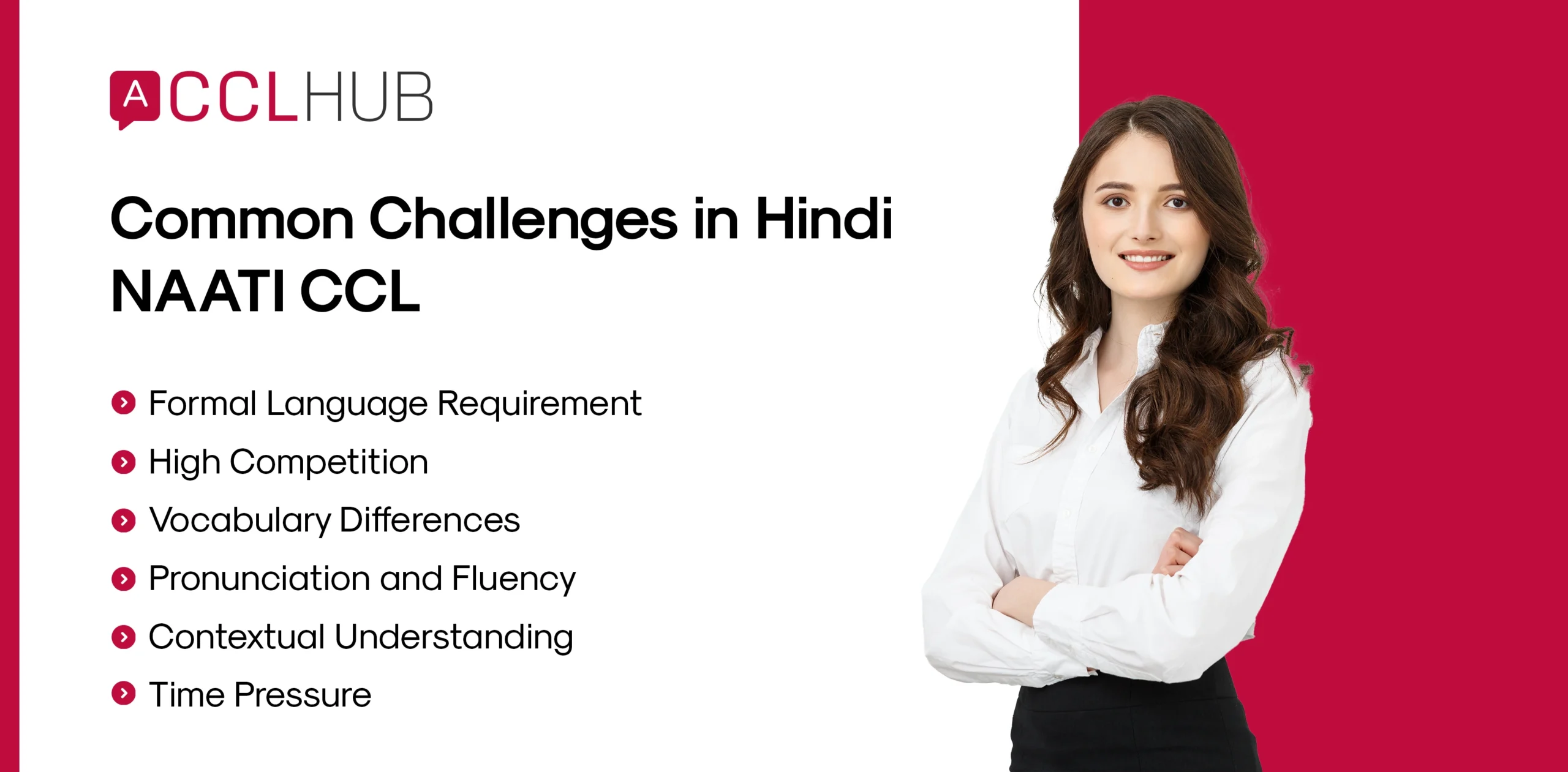
1. Formal Language Requirement
Assessors expect candidates to use standard Hindi. Mixing English with Hindi (“Hinglish”) or using regional dialects can lead to errors in interpretation and lower clarity.
2. High Competition
One of the most popular NAATI CCL decisions is Hindi. Examiners might also be more demanding with marking, particularly in grammar, pronunciation and vocabulary correctness, due to a large number of candidates.
3. Vocabulary Differences
Spoken Hindi in daily life can differ from the formal test-style vocabulary used in NAATI scenarios. Candidates need to practise using standard terms appropriate for professional and community contexts.
4. Pronunciation and Fluency
Certain words may have subtle pronunciation differences depending on regional accents, and these small errors can impact the clarity of interpretation during the test.
5. Contextual Understanding
The NAATI CCL test does not just assess literal translation but also the culture and context. Failure to interpret subtle expressions in the Hindi language, particularly in official matters, can have an influence on performance.
6. Time Pressure
The test is fast-paced, and candidates must interpret accurately in real time. Even fluent speakers need practice to handle both listening and speaking tasks within a limited time.
By understanding these advantages and challenges, candidates can better prepare for the Hindi NAATI CCL and increase their chances of passing and earning 5 PR points for Australia PR.
What are the advantages of Gujarati NAATI CCL?

Why Gujarati Language Can Be Easier
1. Lower Competition
Gujarati NAATI CCL is not normally popular among applicants as compared to Hindi, and this could be to your benefit. In smaller test groups, the competition in general is lower, and the assessors could be better oriented to comprehension and accuracy as compared to strict competition.
2. Focus on Clarity Over Accent
Examiners tend to focus on the clarity and precision of the meaning you are passing across, and not the accent. This is an advantage to the native Gujarati speakers who can read with a lot of confidence without fear of the many regional differences in pronunciation.
3. Natural Fluency for Native Speakers
There are lots of Gujarati candidates who have been speaking this language since their childhood. Such familiarity at the native level assists them in talking regularly, and hence the interpretation becomes easier and more natural during the test.
4. Cultural Comfort
Gujarati speakers tend to find it easier to comprehend context and communal situations (e.g., business, school or social interactions) which replicate real-life use of the language.
Limitations of the Gujarati Language
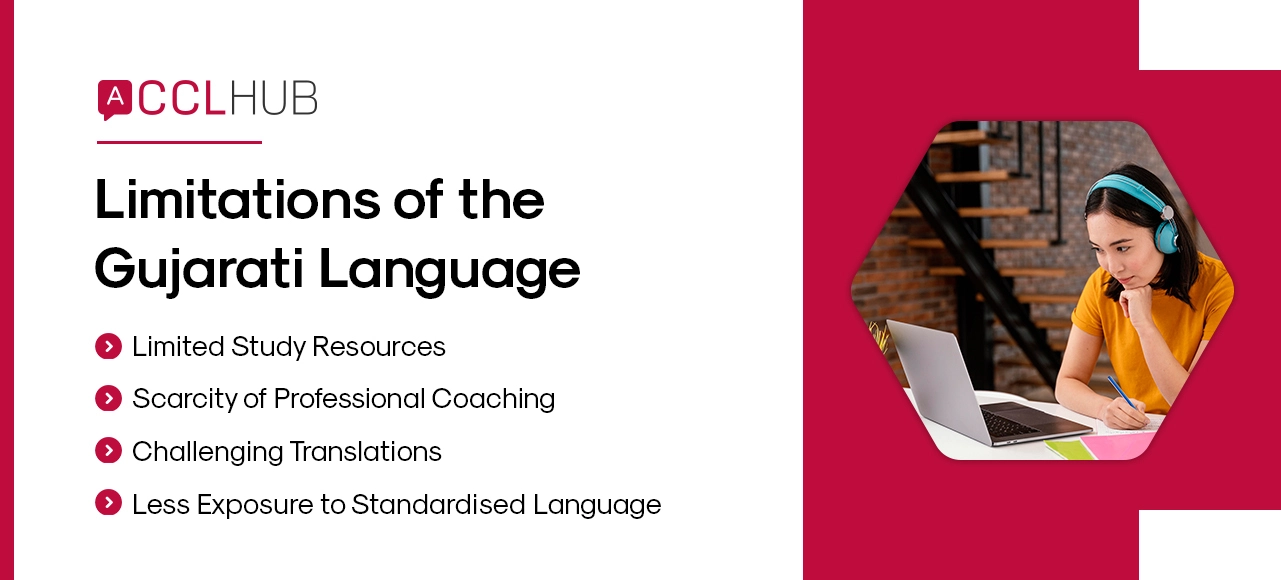
1. Limited Study Resources
Gujarati lacks well-organised materials, web resources and practice tests, compared to Hindi. Applicants tend to be forced to use self-written notes or the assistance of the local community.
2. Scarcity of Professional Coaching
The professional tutors or special NAATI training courses for Gujarati are fewer, and it may be more difficult to get guided learning and systematic feedback.
3. Challenging Translations
Certain English words, particularly in technical usage as in the case of law, medicine or governmentese, may be hard to directly translate into Gujarati without a loss of meaning. This involves additional practice to work with such terminology.
4. Less Exposure to Standardised Language
Although the majority of the Gujaratis are fluent speakers, the test also uses formal and standardised Gujarati. The individuals who primarily speak regional forms will require more practice to fit the expectations set by NAATI.
Key Comparison — Hindi vs Gujarati NAATI CCL
| Category | Hindi NAATI CCL | Gujarati NAATI CCL |
| Popularity | One of the most common languages chosen by Indian migrants; large candidate pool. | Smaller candidate pool with fewer test-takers. |
| Competition Level | High competition; stricter assessment due to large number of applicants. | Lower competition; assessors often focus on communication clarity. |
| Availability of Study Resources | Abundant – books, mock tests, online tutorials, and coaching centers widely available. | Limited – fewer online materials and structured practice tests. |
| Access to Tutors | Many professional tutors and NAATI preparation courses available both online and offline. | Limited coaching options; may need to rely on community tutors or self-study. |
| Grammar Complexity | Moderate – familiar structure for most North Indians; widely used vocabulary. | Slightly more complex; requires understanding of formal Gujarati grammar. |
| Dialects and Variations | Several dialects (e.g., Bhojpuri, Marwari, Haryanvi) – must stick to standard Hindi. | Fewer dialectal variations; standard Gujarati is fairly consistent. |
| Pronunciation Challenges | Some tonal differences and regional variations may cause minor confusion. | Pronunciation is relatively uniform, but attention to clarity is key. |
| Cultural Familiarity | Common for most Indian migrants; easy to relate to test scenarios. | Strong among Gujarati-speaking migrants; comfortable with community-based topics. |
| Translation Difficulty (English ↔ Regional Language) | Easier for general and conversational contexts. | Certain specialised English terms (legal, medical) can be tricky. |
| Learning Curve for Non-Native Speakers | Shorter – plenty of exposure through media, daily use, and resources. | Slightly steeper – limited resources but easier for native Gujaratis. |
| Scoring Potential for PR Points | High – with proper preparation, passing is straightforward. | High – native speakers often pass comfortably with practice. |
Which NAATI CCL Language Is Easiest to Pass?
In the case of the selection of the simplest NAATI CCL language to pass, your choice will mostly depend on your language skills and level of comfort. Hindi NAATI CCL is generally more comfortable for most of the Indian migrants due to its prevalence, familiarity and the fact that there are more preparation resources.
Candidates have the opportunity to study effectively and without fear with the help of the many online courses, sample dialogues, and professional tutors. Moreover, the grammar and vocabulary of Hindi are familiar to a large portion of the Indian population in other regions, which makes it easier to learn the language in a structured manner and learn it faster.
Yet, when it comes to native Gujarati speakers, the Gujarati NAATI CCL test may be as simple as easy. The test can also be less competitive, as it is a smaller community language, and there are fewer applicants, and assessors tend to be more concerned with clarity and accuracy rather than with the slightest differences in accents.
The most important one is fluency; when you speak a language that you are used to thinking, speaking, and interpreting in, you are the most likely to succeed. It may be Hindi or Gujarati, but it is the practice and exposure to more professional words and situations in society that really make the NAATI CCL test easier to pass and get you those precious 5 PR points on behalf of Australia PR.
Real-Life Experiences from Hindi vs Gujarati NAATI CCL Candidates
To better understand how the language choice affects success, here are real examples from students who cleared the test with CCLHub.com.au’s expert help.
1. Aditi Sharma — Hindi NAATI CCL Candidate
“I grew up in Delhi and was confident in my Hindi, but when I started preparing, I realised the test required more formal vocabulary. I joined CCLHub.com.au, where I chose the Unlimited Hindi Package for more resources, which included guidance from my mentor on my pronunciation, tone, and register.
The mock examinations were designed in the same way as the actual test. I got my 5 PR points and Hindi CCL first, only after two months of constant feedback, and I graduated the course successfully!”
2. Harsh Patel — Gujarati NAATI CCL Candidate
“Although I communicate in Hindi, my mother tongue is Gujarati, and I speak it with the family members daily. I found it easier to talk about feelings in Gujarati and everyday life in Gujarati.
CCLHub.com.au had fewer Gujarati resources compared to Hindi, but the tutors provided custom dialogues and vocabulary lists for me. I chose Unlimited Gujarati Language for better resources, and it worked. The content and their feedback helped me avoid literal translations.
I cleared my Gujarati CCL easily and now recommend others to choose their native language if they’re fluent!”
Expert Tips to Score Higher in Any NAATI CCL Language
1. Focus on Accuracy, Not Speed
The NAATI CCL test values accuracy in interpretation rather than speed. Allow yourself a moment between sections to make sure that you are getting the meaning and feel of what you are saying.
2. Practise Real-Life Scenarios
The test is designed to simulate real-world situations in the community, such as doctor visits, parent-teacher meetings and government appointments. Use these kinds of conversations regularly to gain confidence and use context-related words.
3. Build a Strong Vocabulary Bank
Develop a list of commonly used words and phrases in both languages (English and your language of choice). Pay attention to the medical, legal, educational, and social service contexts, which are the most frequently used in the test and have formal terms.
4. Record and Review Your Practice Sessions
You can listen to your recordings to find out how you make a mistake in pronunciation, grammar or fluency. This is an exercise that you practise so that you can learn to interpret naturally, clearly, and understandably when you are in a test situation.
5. Learn to Paraphrase Naturally
You do not have to translate the words. Rather, aim at providing the same meaning in a culturally befitting and fluent manner. This is a manifestation of a fair knowledge of both languages.
6. Avoid Mixing Languages
Whether it’s “Hinglish”, “Gujlish”, or any regional blend, assessors expect a clean interpretation in standard English and standard community language. Mixing languages can lead to score deductions.
7. Stay Calm and Manage Your Time
The test is not very long, but it is intense. Try managing time to be able to cope with both conversations without being in a hurry. Being calm enables you to reason and make sense out of things.
8. Enrol in a Preparation Course
A formal NAATI CCL course provides simulation tests, professional guidance and actual exam simulation, assisting you with the marking guidelines as well as preventing typical errors.
9. Master Note-Taking Techniques
Learn to jot down key ideas, numbers, and details quickly during the dialogue. Effective note-taking ensures you don’t miss important points while interpreting.
10. Practice Active Listening
Concentrate on both content and tone while listening to the dialogues. Understanding emotions, intentions, and context helps you deliver a more natural and accurate interpretation.
Final Verdict — Hindi or Gujarati NAATI CCL Language for NAATI CCL?
In choosing between Hindi and Gujarati in relation to the NAATI CCL test, the most viable option would always be your level of language and the level of comfort you have in preparing the language and the level of preparation tools that are available. Hindi NAATI CCL is usually the most convenient and simpler choice in case you are a fluent Hindi speaker or have been raised using Hindi both in school and in everyday life. It provides a lot of study material, fake exams, and professional tutorship – preparation is easier and more organised. But it is also accompanied by a greater rivalry level and tougher assessment since it is among the most sought-after language choices among the Indian migrants.
Alternatively, when you speak Gujarati as your native language or the language in the homestead, the Gujarati NAATI CCL can be the easy way out. Set in an environment where there is less competition and where assessors tend to emphasise more on the understanding and clarity than the accent, the native Gujarati speakers tend to feel more natural in taking this test.
The only disadvantage is that learning sources and professional coaching are less available as compared to Hindi. To conclude, you should select the language that you can think, interpret and communicate in without any problem; that is the actual key to passing the NAATI CCL test and gaining 5 PR points to the value of your Australia PR.
NAATI TEST SAMPLE!
Get Naati CCL Free Test Samples
Conclusion
The NAATI CCL test is an excellent chance for migrants to earn an additional 5 PR points towards their permanent residency in Australia. With or without Hindi or Gujarati, it is the success of your interpretation of English and your own community language that you are very comfortable with, and that comes out right.
Hindi NAATI CCL provides broader preparation content, guided courses, and known vocabulary, which is why it is an effective option among many Indian applicants. In the meantime, it might be less competitive and more natural for Gujarati NAATI CCL since they are more likely to use the language in their daily life.
